
Overview
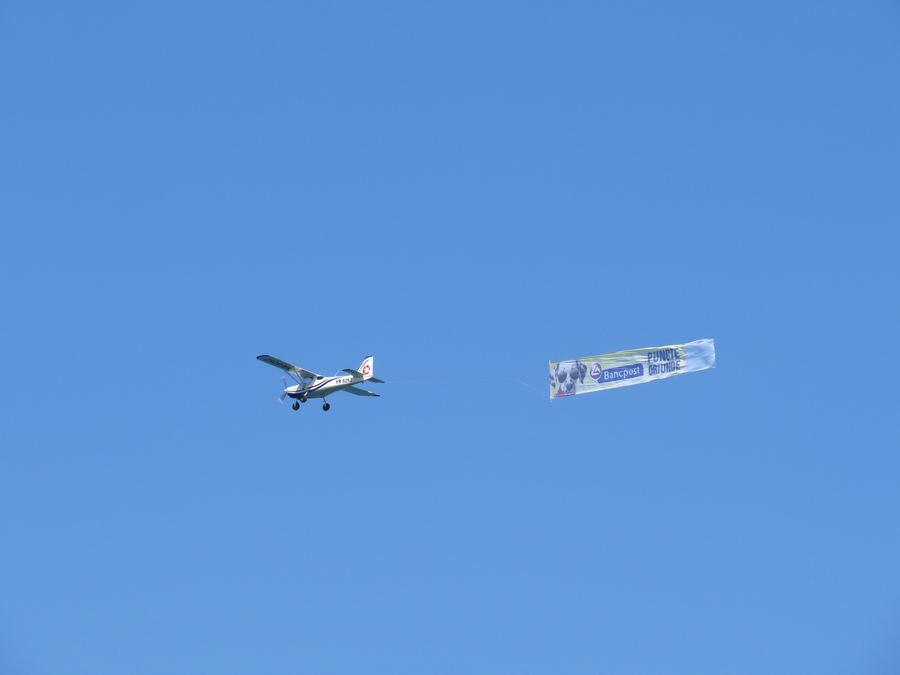
Aerial advertising uses aircraft, balloons, drones, or other airborne platforms to display or carry advertising messages, ranging from static banners and painted liveries to dynamic formats like skywriting and illuminated signage. Banner towing, the most common form, involves a light aircraft picking up a pre-assembled banner from ground poles and towing it at low speed and altitude. The practice dates back over a century, with the first recorded advertising use occurring in 1922 when a former Royal Air Force pilot skywrote a newspaper's name over the Epsom Derby. Modern variants have expanded to include drone-carried banners and foam-based floating logo displays, though stricter altitude regulations and urban flight restrictions have caused a long-term decline in traditional banner towing since its 1970s peak.
History
The first recorded use of aerial advertising dates to 1922, when a former Royal Air Force pilot skywrote a newspaper's name in the sky above the Epsom Derby in England, drawing widespread public attention to the new medium. Banner towing became commercially established through the mid-20th century as light aircraft manufacturing matured, and beach and stadium banner advertising became a common sight over major US cities by the 1970s. Since the 2000s, increasingly strict altitude regulations and urban flight restrictions have caused traditional banner towing to decline from its earlier peak, while drone-carried banners and newer floating-logo display technologies have emerged as modern alternatives.
Design & Specifications
Banner-towing rigs consist of a lightweight aircraft, typically a Piper Super Cub or Cessna 172, fitted with a tow hook and a release mechanism the pilot can trigger from the cockpit if needed for an emergency drop. The banner itself is assembled from individual letters or panels connected by a lightweight frame and towline, engineered to stay rigid and readable at typical viewing distances of a few hundred feet. Skywriting aircraft use a different system entirely, injecting a specialized oil into the hot exhaust stream to generate a dense, slow-dispersing white smoke trail that the pilot shapes into letters through precise, practiced flight maneuvers. Modern drone-based aerial advertising uses much smaller banner rigs suspended beneath a multirotor drone, trading altitude and visibility range for lower operating cost.
Operations
A typical banner-towing flight begins with the aircraft flying low over ground poles holding the banner aloft, where a trailing hook catches the towline as the plane passes overhead. Once airborne with the banner attached, the pilot climbs to a cruising altitude and flies a repeated pattern over the target audience, such as a beach or stadium. Skywriting requires flying at higher altitude, generally 10,000 feet or more, following a precisely timed flight path to trace each letter legibly before the smoke disperses. Regulatory authorities typically impose minimum altitude and populated-area restrictions on both activities, given the sustained low-speed flight over crowds involved.
See also
References
| Category | Special Operations & General Aviation |
| Type | Aerial marketing |
| Method | Banner towing, skywriting |
| First Use | Epsom Derby, 1922 |
| Common Aircraft | Piper Super Cub, Cessna 172 |