
Overview
A turboprop is a gas turbine engine that drives an external propeller through a reduction gearbox, combining the mechanical simplicity and torque advantages of propeller propulsion with the greater power and altitude capability of turbine technology, compared to piston engines. Turboprops are most efficient at lower speeds and altitudes than pure jet engines, which is why they remain the standard choice for regional airliners, small cargo aircraft, and many military transport and trainer aircraft flying shorter routes. Popular turboprop airliners are widely used by regional carriers worldwide for routes too short or low-volume to justify jet service. Compared to turbofans, turboprops offer better fuel efficiency and shorter runway performance at typical regional-airline cruising speeds, though they can't match a turbofan's higher cruise speed or altitude capability on longer routes.
History
Turboprop engine development began in the 1940s, combining gas turbine technology with traditional propeller propulsion to improve on piston engine performance at regional-aircraft speeds and altitudes. The technology matured rapidly through the 1950s and 1960s as manufacturers refined reduction gearbox designs connecting the turbine to the external propeller. Regional airliner turboprops such as those built by ATR and de Havilland Canada became especially prominent from the 1980s onward, as regional airlines sought aircraft optimized for the shorter routes and lower passenger volumes where turboprops remain more fuel-efficient than jet engines.
Design & Specifications
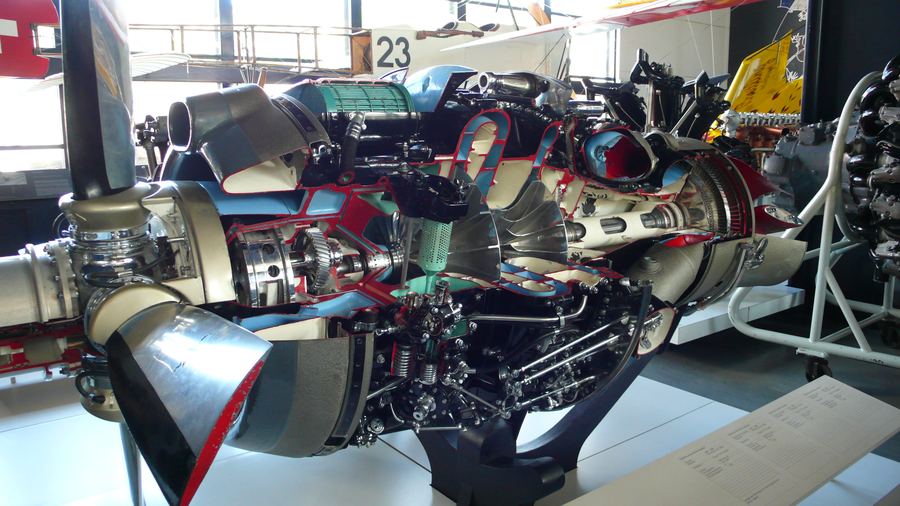
A turboprop couples a gas turbine core to an external propeller through a reduction gearbox, which slows the turbine's high rotational speed down to the much lower speed at which a propeller operates most efficiently. Propeller blades on a turboprop are typically variable-pitch, letting the angle of each blade adjust for different flight phases, from a fine pitch for takeoff acceleration to a coarser pitch for efficient cruise. Turboprop engines are generally lighter and more compact than a piston engine of comparable power output, though they require more specialized maintenance given their gas turbine core components. Air intake and exhaust design on a turboprop is optimized differently than a pure jet engine, since most of the engine's usable energy is delivered through the propeller rather than through direct exhaust thrust.
Operations
Pilots manage turboprop engines through a power lever controlling turbine output and, on many aircraft, a separate propeller lever controlling blade pitch and rotational speed independently. Turboprop aircraft typically demonstrate strong takeoff and climb performance from relatively short runways, a key operational advantage over turbofan-powered aircraft on regional routes with less-developed airport infrastructure. Scheduled maintenance for turboprop engines includes regular borescope inspections and propeller-specific maintenance alongside standard turbine engine service intervals. Because turboprops are most efficient at lower altitudes and speeds than turbofans, airlines operating them typically plan shorter route segments and lower cruise altitudes than they would for a comparable turbofan-powered aircraft.
See also
References
| Category | Fuel & Powerplants |
| Type | Propeller-driving gas turbine |
| Introduced | 1940s |
| Used On | Regional airliners, military transport |
| Examples | ATR 42/72, Dash 8 |