Overview
In aviation, pushback is the procedure of moving an aircraft backward away from its gate using an external tug or tractor, rather than the aircraft using its own engines to reverse. While many aircraft can technically move backward under their own reverse thrust — a maneuver called a powerback — doing so risks jet blast, flying debris, and excess engine wear, all of which a pushback tractor avoids. Because of these safety and equipment risks, pushback by tug has become the standard method for moving aircraft away from airport gates worldwide. The tractors used for this task are low-profile vehicles specifically designed to attach to an aircraft's nose or main landing gear and maneuver it safely across the ramp area.
History
Pushback procedures developed as commercial jet aircraft grew larger and more powerful in the 1950s and 1960s, when using an aircraft's own reverse thrust to back away from a gate became increasingly risky due to jet blast and flying debris. Purpose-built pushback tractors were developed through the 1960s and 1970s specifically to move aircraft safely without relying on engine power, becoming standard equipment at airports handling jet traffic worldwide. The practice has remained largely unchanged in basic principle since, though modern tugs have grown more powerful and, in some newer designs, more automated to handle increasingly large wide-body aircraft.
Design & Specifications
Pushback tugs are low-profile vehicles built to fit beneath an aircraft's nose or connect to its landing gear, with enough torque to move an aircraft weighing hundreds of thousands of pounds despite the tug itself being far lighter. Conventional tugs use a rigid or articulated tow bar connected to the aircraft's nose gear, while newer towbarless tugs instead lift and cradle the nose wheel directly, avoiding the risk of a separate tow bar failing under load. Tug operators communicate with the cockpit via headset connection or hand signals throughout the pushback, coordinating brake release, steering, and the final disconnect point precisely. Modern tugs increasingly incorporate electric or hybrid propulsion, reducing emissions and noise on the ramp compared to older diesel-powered designs.
Operations
A pushback operation begins once the aircraft is ready to depart the gate, with ground crew connecting the tug and confirming clear communication with the flight crew before releasing the parking brake. The tug operator pushes the aircraft backward away from the gate along a predetermined path, watching carefully for other aircraft, vehicles, and ground personnel in the confined ramp area. Once clear of the gate area and pointed toward the taxiway, the tug disconnects, the aircraft's engines start or continue running, and the aircraft taxis away under its own power. Coordinating pushback timing across dozens of simultaneous gate departures is a significant part of managing overall ramp traffic flow at a busy airport.
See also
References
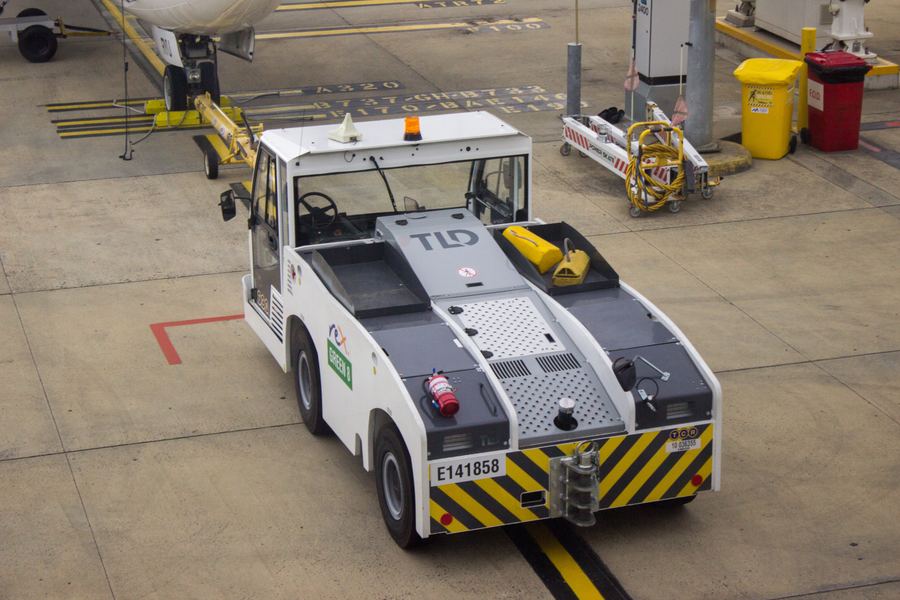
| Category | Airport & Ground Infrastructure |
| Type | Ground support vehicle |
| Function | Pushback / towing |
| Alternative | Powerback (reverse thrust) |
| Status | Standard worldwide |