Overview
Traffic alert and collision avoidance system (TCAS), also called an airborne collision avoidance system (ACAS), is an aircraft collision avoidance system designed to reduce the incidence of mid-air collisions between aircraft. It monitors the airspace around an aircraft for other aircraft equipped with a corresponding active transponder, operating independently of air traffic control, and warns pilots of nearby transponder-equipped aircraft that may present a collision risk. TCAS is mandated by the International Civil Aviation Organization to be fitted on all aircraft with a maximum takeoff mass over 5,700 kg or authorized to carry more than 19 passengers, making it standard equipment across virtually the entire commercial airliner fleet. When TCAS detects a genuine collision risk, it issues a resolution advisory directly to the flight crew, instructing a specific climb or descent maneuver, and modern TCAS units coordinate directly between the two threatened aircraft to ensure they receive complementary, non-conflicting instructions.
History
Early collision avoidance system concepts were explored following several high-profile mid-air collisions in the 1950s and 1960s that highlighted gaps in relying solely on air traffic control and visual scanning to prevent aircraft from colliding. TCAS technology development accelerated significantly following a 1978 mid-air collision over San Diego, which added urgency to the FAA's ongoing collision avoidance research programs. The FAA mandated TCAS II equipment on most large commercial aircraft starting in the early 1990s, following extensive testing and refinement of the system's collision-detection and resolution-advisory logic. TCAS has since become standard equipment worldwide on aircraft above the mandated weight and passenger thresholds, and its resolution advisory logic has continued to be refined based on real-world operational experience and occasional near-miss or collision incidents.
Design & Specifications
A TCAS unit continuously interrogates nearby aircraft transponders and calculates each detected aircraft's relative position, altitude, and closure rate, comparing this data against defined collision-risk thresholds. When TCAS detects a developing collision risk, it first issues a traffic advisory, alerting the crew to the nearby aircraft's position, and if the situation continues to develop, follows with a resolution advisory instructing a specific climb or descend maneuver. TCAS units aboard two threatened aircraft coordinate directly with each other over a dedicated data link, ensuring the resolution advisories issued to each aircraft are complementary rather than conflicting. The system operates independently of ground-based air traffic control, providing a final layer of collision protection even if a controller error or communication breakdown were to occur.
Operations
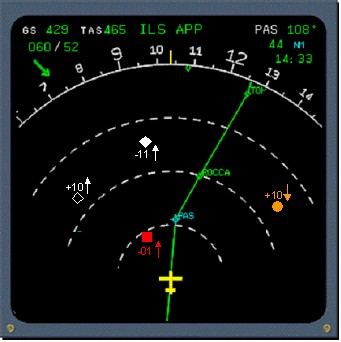
Pilots are trained to respond immediately to a TCAS resolution advisory, following the system's climb or descend instruction even if it conflicts with a simultaneous air traffic control instruction, since TCAS guidance takes priority in that specific situation. TCAS displays in the cockpit continuously show nearby traffic during normal flight, giving pilots ongoing situational awareness beyond what an advisory alert alone would provide. Maintenance and certification of TCAS units includes periodic testing to confirm the system's interrogation and advisory logic functions correctly across the full range of scenarios it's designed to handle. Regulatory authorities collect and analyze data from TCAS resolution advisory events, using it to refine air traffic procedures and identify recurring situations that lead to close encounters between aircraft.
See also
References
| Category | Avionics & Flight Systems |
| Type | Airborne collision avoidance system |
| US Mandate Era | Early 1990s |
| ICAO Requirement | >5,700 kg or >19 passengers |
| Status | Standard on commercial aircraft |