
Overview
Avgas, short for aviation gasoline, is the leaded fuel used almost exclusively by piston-engine aircraft, most commonly in the 100LL (100 octane, low lead) grade that remains the standard fuel for general aviation training and recreational aircraft worldwide. Unlike automotive gasoline, avgas still contains tetraethyl lead as an anti-knock additive, since piston aircraft engines require higher octane ratings than most road vehicles and lead-free alternatives have historically struggled to match avgas's performance across the range of engine types in service. This makes avgas one of the last widely used leaded fuels anywhere in the world, and it has drawn increasing environmental and regulatory scrutiny in recent years. Several unleaded avgas alternatives have been developed and are gradually being certified and rolled out across general aviation fleets, with regulators in multiple countries pushing industry-wide efforts to eliminate leaded avgas.
History
Leaded aviation gasoline became standard in the mid-20th century as tetraethyl lead proved effective at boosting the octane rating piston aircraft engines required for reliable high-performance operation. The 100LL (100 octane, low lead) grade was introduced in the 1970s as a lower-lead alternative to earlier, more heavily leaded formulations, and it has remained the dominant avgas standard for general aviation ever since. Environmental and regulatory pressure to eliminate leaded fuel entirely has grown substantially since the 2010s, with the US EPA and FAA both supporting industry-wide efforts to certify and roll out unleaded avgas alternatives across general aviation fleets by the end of the 2020s.
Design & Specifications
Avgas 100LL is formulated to a strict international specification controlling its octane rating, vapor pressure, and freezing point, ensuring consistent performance across the wide range of piston aircraft engines that rely on it. The fuel contains a small but carefully controlled amount of tetraethyl lead, added specifically to boost octane rating and prevent engine knock under the high compression ratios many aircraft piston engines use. Avgas is dyed blue to visually distinguish it from other aviation and automotive fuels, helping prevent accidental misfueling at airports that stock multiple fuel types. Unleaded avgas alternatives currently in development and certification aim to match 100LL's performance characteristics closely enough to be usable across the existing piston aircraft fleet without engine modifications.
Operations
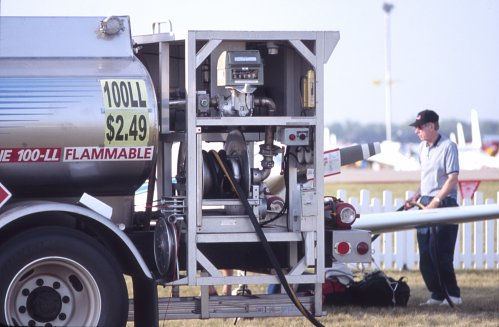
Avgas is delivered to aircraft either from a fixed fuel storage tank via a dedicated fuel truck or hydrant system, or in some cases pumped directly from a self-service fueling station at smaller general aviation airports. Fueling personnel or pilots follow strict grounding and static-discharge procedures during refueling to prevent the risk of fuel vapor ignition. Fuel quality testing, including checks for water contamination and proper coloring, is a routine part of daily fuel farm operations at any airport dispensing avgas. Because avgas remains a leaded fuel, some airports and regulators have begun implementing additional environmental monitoring and, in some cases, transition programs toward unleaded alternatives.
See also
References
| Category | Fuel & Powerplants |
| Type | Leaded piston-engine fuel |
| Standard Grade | 100LL (100 octane, low lead) |
| Status | Being phased toward unleaded |
| Target | Unleaded transition by late 2020s |