
Overview
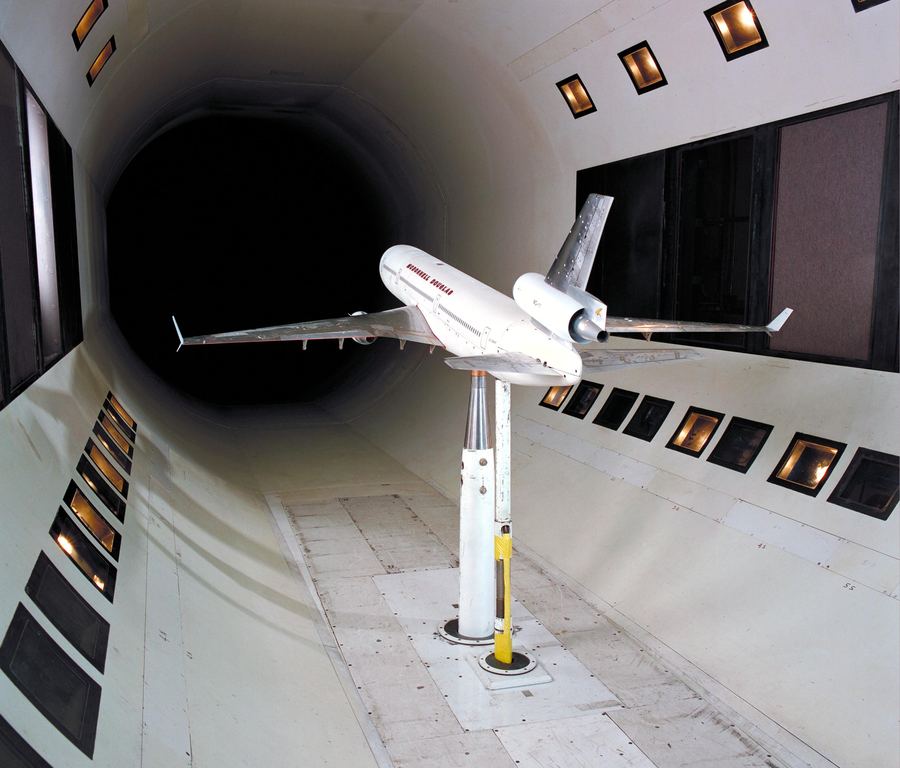
A wind tunnel is an apparatus for producing a controlled stream of air used to conduct aerodynamic experiments, with the test itself carried out in a dedicated test section while air ducting and a fan or other device keep the airflow moving continuously. Wind tunnels are used to assess how air affects an aircraft in flight, how wind affects ground vehicles, buildings, and bridges, and to validate aerodynamic designs before committing to full-scale prototypes. Test section sizes vary enormously, from under a foot across for small-scale model testing up to over 100 feet for testing full-size aircraft components or entire small aircraft. Wind tunnel testing remains a critical step in aircraft development even in the era of advanced computational fluid dynamics, since physical testing continues to reveal real-world aerodynamic behaviors that simulations alone can miss.
History
The Wright brothers built and used one of the earliest practical wind tunnels in 1901, specifically because they found existing published aerodynamic data to be unreliable for their glider and aircraft designs. Wind tunnel technology expanded significantly through the early 20th century as aviation matured from an experimental pursuit into an established industry requiring more rigorous design validation. Large-scale wind tunnels capable of testing full-size aircraft components, some over 100 feet across, were built by government and military research agencies through the mid-20th century to support increasingly ambitious aircraft programs. Despite the rise of computational fluid dynamics in recent decades, physical wind tunnel testing has remained an essential validation step in aircraft development, since it continues to reveal real-world aerodynamic behaviors that simulations alone can miss.
Design & Specifications
Wind tunnels use powerful fans to generate controlled airflow over scale models or full-size components, with sensors measuring resulting forces and airflow patterns.
Operations
Engineers run wind tunnel tests throughout aircraft development, validating designs before committing to expensive full-scale prototypes.
See also
References
| Category | Aerodynamics & Aircraft Anatomy |
| Type | Aerodynamic testing apparatus |
| Early Example | Wright brothers, 1901 |
| Modern Size Range | Under 1 ft to 100+ ft |
| Status | Still used alongside CFD |