
Overview
When a fluid flows around an object, it exerts a force on that object, and lift is the component of that force acting perpendicular to the oncoming flow direction, in contrast to drag, which acts parallel to the flow. Lift conventionally acts upward to counter gravity, though it can act in any direction perpendicular to the airflow depending on the object's orientation. Dynamic lift, generated by an object's motion through a fluid, is distinct from aerostatic lift or buoyancy, which relies on an internal gas being lighter than the surrounding air and requires no forward movement, as used by balloons and airships. Generating and controlling lift efficiently is one of the central challenges of aircraft design, since a wing's shape, angle of attack, and speed all directly determine how much lift it produces at any given moment.
History
Early theories of lift in the 18th and 19th centuries relied heavily on basic fluid dynamics principles, with figures like Daniel Bernoulli and Sir George Cayley laying foundational groundwork decades before powered flight was achieved. The Wright brothers' own wind tunnel testing in 1901 was directly motivated by inaccuracies they found in existing published lift data, leading them to generate their own more reliable aerodynamic measurements. Understanding of lift generation deepened substantially through the 20th century as aerodynamic theory matured alongside increasingly sophisticated wind tunnel and, later, computational testing methods. Despite over a century of study, some aspects of exactly how lift is generated remain subjects of ongoing explanation and refinement among aerodynamicists, even though the practical engineering used to generate and control lift is extremely well established.
Design & Specifications
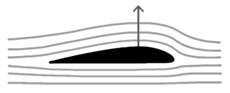
Lift is generated as air flows over a wing's curved upper surface and along its lower surface, creating a pressure difference calculated using the wing's airfoil shape and angle of attack.
Operations
Pilots manage lift throughout flight by adjusting airspeed, angle of attack, and flap settings to match the aircraft's weight and desired flight path.
References
| Category | Aerodynamics & Aircraft Anatomy |
| Type | Aerodynamic force |
| Direction | Perpendicular to airflow |
| Early Research | Wright brothers wind tunnel, 1901 |
| Distinct From | Aerostatic lift (buoyancy) |