
Overview
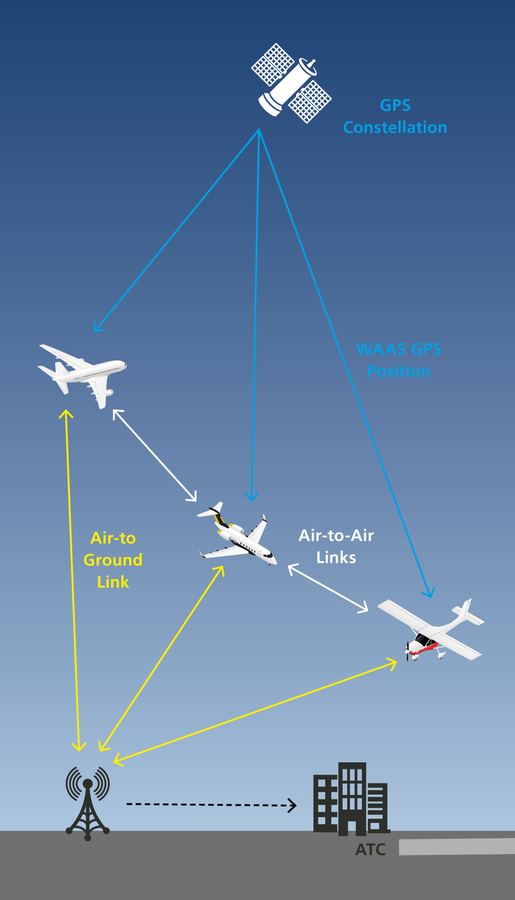
Automatic Dependent Surveillance–Broadcast (ADS-B) is an aviation surveillance technology in which an aircraft determines its position via satellite navigation and periodically broadcasts that position and related data, letting it be tracked by ground-based or satellite-based receivers as a modern replacement for secondary surveillance radar. Unlike radar, ADS-B doesn't require an interrogation signal from the ground or another aircraft to trigger its transmissions, since the aircraft broadcasts its position automatically and continuously. Aircraft equipped with ADS-B can also receive transmissions directly from other nearby ADS-B-equipped aircraft, providing pilots with real-time traffic situational awareness independent of ground-based air traffic control. Many countries have mandated ADS-B equipment for aircraft operating in controlled airspace, reflecting how central the technology has become to modern air traffic surveillance.
History
ADS-B technology development began in the 1990s as aviation authorities and industry sought a more precise and cost-effective alternative to traditional secondary surveillance radar for tracking aircraft. Early ADS-B trials and limited deployments took place through the 2000s, as the technology's reliance on GPS positioning data promised significantly more accurate aircraft tracking than radar-based systems could provide. The FAA mandated ADS-B Out equipment for aircraft operating in most US controlled airspace starting January 1, 2020, following a lengthy phase-in period that gave operators years to equip their aircraft ahead of the deadline. Similar mandates have since been adopted or are being phased in across many other countries, reflecting a broader global shift toward satellite-based aircraft surveillance as the standard replacement for aging ground-based radar infrastructure.
Design & Specifications
An ADS-B Out system aboard an aircraft combines a GPS position source with a dedicated transponder that broadcasts the aircraft's position, altitude, velocity, and identification roughly once per second on a standardized radio frequency. Ground-based and, increasingly, satellite-based receivers pick up these broadcasts and relay the data to air traffic control systems, providing more frequent and precise position updates than traditional radar can achieve. ADS-B In equipment, an optional addition beyond the mandatory ADS-B Out, lets an aircraft also receive broadcasts from nearby equipped aircraft, displaying real-time traffic information directly in the cockpit. The system operates on one of two standardized frequencies depending on region and aircraft category, requiring compatible equipment on both the transmitting aircraft and receiving ground infrastructure.
Operations
Air traffic controllers use ADS-B data as a supplement to or replacement for traditional radar, benefiting from more frequent position updates and, in some remote or mountainous areas without radar coverage, from surveillance capability that wouldn't otherwise exist. Pilots equipped with ADS-B In can view nearby traffic directly on a cockpit display, improving situational awareness beyond what visual scanning or radio calls alone would provide. Regulatory compliance monitoring uses ADS-B data automatically, since any aircraft transmitting its position can be checked against required equipment and certification standards for the airspace it's operating in. Airlines and operators use aggregated ADS-B data for operational purposes beyond safety as well, including tracking fleet-wide fuel efficiency and analyzing actual flown routes against planned ones.
See also
References
| Category | Avionics & Flight Systems |
| Type | Satellite-based surveillance |
| Introduced | 1990s-2000s development |
| US Mandate | January 1, 2020 |
| Status | Standard in controlled airspace |