
Overview
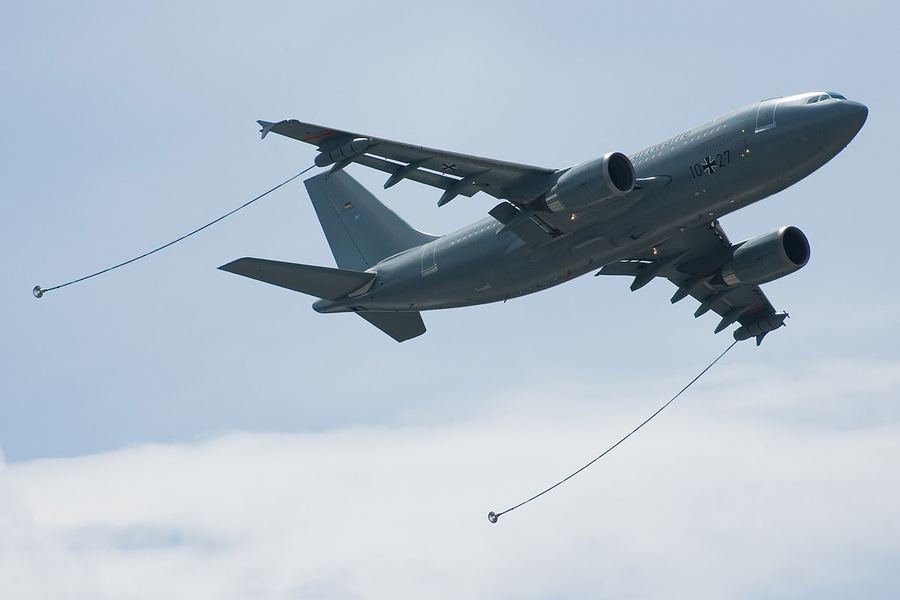
Aerial refueling, also called air refueling, in-flight refueling, or air-to-air refueling, is the process of transferring aviation fuel from one aircraft, the tanker, to another, the receiver, while both aircraft remain in flight. The two main refueling systems in use are probe-and-drogue, which is simpler to adapt to existing aircraft designs, and the flying boom, which offers faster fuel transfer but requires a dedicated boom operator station aboard the tanker aircraft. This procedure lets the receiving aircraft remain airborne considerably longer, extending its effective range or time on station without needing to land and refuel conventionally. Aerial refueling has become a cornerstone capability for modern air forces, letting fighter, bomber, and transport aircraft undertake missions far beyond what their internal fuel capacity alone would otherwise allow.
History
Aerial refueling technology was first successfully demonstrated in the 1920s, though it remained largely experimental for decades before military applications drove serious development investment. The probe-and-drogue and flying boom refueling systems still used today were both developed and refined during the mid-20th century, with the US Air Force adopting the flying boom system for its heavier bombers and the US Navy favoring probe-and-drogue for carrier-based aircraft. Aerial refueling capability became increasingly central to military air power projection during the Cold War, letting bomber and fighter aircraft operate at ranges far beyond what their internal fuel capacity alone would allow. Modern military air forces continue to rely heavily on dedicated tanker aircraft fleets, and aerial refueling capability remains a key factor distinguishing which countries can project air power over truly global distances.
Design & Specifications
Tanker aircraft carry large internal fuel tanks connected to either a trailing hose-and-drogue system or a rigid flying boom for transfer.
Operations
Tanker crews rendezvous with receiving aircraft at planned points, transferring fuel during a carefully flown formation refueling procedure.
References
| Category | Military Aviation & Defense Systems |
| Type | Aerial refueling tanker |
| First Demonstrated | 1920s |
| Systems | Probe-and-drogue, flying boom |
| Purpose | Extend aircraft range |