
Overview
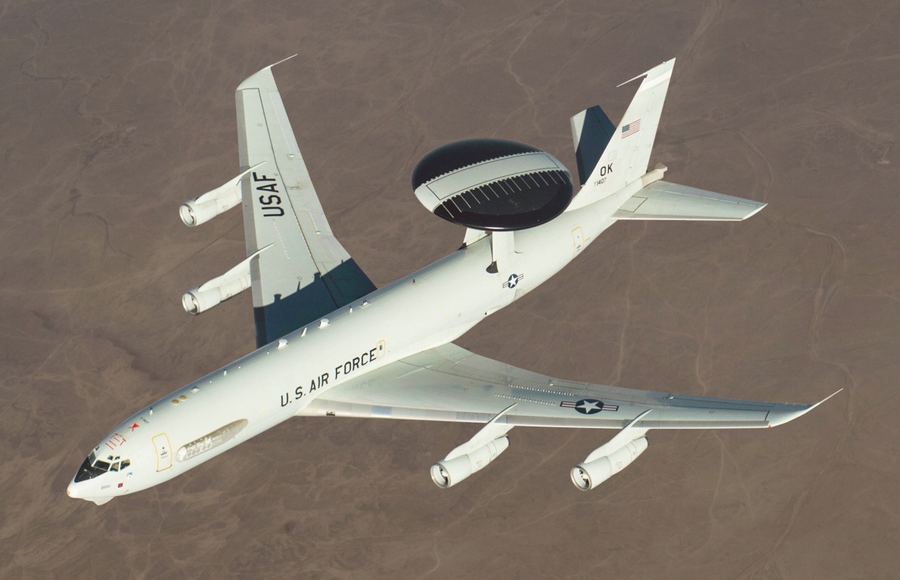
An airborne early warning and control (AEW&C) system is an airborne radar early warning system designed to detect aircraft, ships, vehicles, missiles, and other incoming threats at long range, while also performing command and control of the battlespace during aerial engagements by informing and directing friendly fighter and attack aircraft. AEW&C units also carry out aerial surveillance over ground and maritime targets and frequently perform battle management command and control functions. When operated at high altitude, the radar system aboard an AEW&C aircraft can detect threats at ranges far beyond what any ground-based radar installation could achieve, given the much greater line-of-sight distance available from altitude. The Boeing E-3 Sentry, used by several air forces including the Royal Air Force and US Air Force, is among the best-known AEW&C platforms, instantly recognizable by its large rotating radar dome mounted above the fuselage.
History
Early airborne early warning concepts were tested during World War II, as military forces recognized that radar mounted on an aircraft could detect incoming threats at far greater range than any ground-based installation, given the much greater line-of-sight distance available from altitude. AEW&C technology matured significantly during the Cold War, as the threat of high-speed jet bomber and missile attacks made early detection increasingly critical to national air defense planning. The Boeing E-3 Sentry, which entered service in the late 1970s, became the definitive Western AEW&C platform for decades, instantly recognizable by its large rotating radar dome and operated by numerous allied air forces beyond the United States. AEW&C aircraft have continued evolving since, incorporating increasingly sophisticated radar and battle management systems that let them coordinate complex, networked air operations well beyond their original Cold War-era air defense mission.
Design & Specifications
AEW&C aircraft carry large rotating or fixed radar arrays alongside extensive communication and data-processing systems.
Operations
AEW&C crews monitor airspace continuously, directing friendly fighters and coordinating battle management during complex air operations.
| Category | Military Aviation & Defense Systems |
| Type | Airborne early warning aircraft |
| Also Called | AEW&C |
| Best-Known Example | Boeing E-3 Sentry |
| Entered Service | Late 1970s |