
Overview
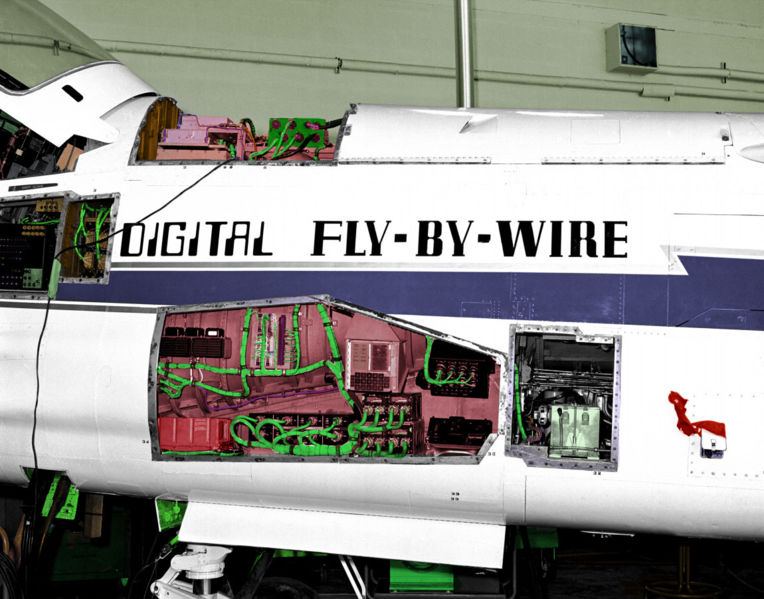
Fly-by-wire (FBW) is a system that replaces an aircraft's conventional manual flight controls with an electronic interface, converting the movements of the pilot's controls into electronic signals that flight control computers interpret to determine how to move the actuators at each control surface. Implementations either retain a mechanical backup control system or operate as a fully electronic system with no direct mechanical link between the controls and the surfaces at all. More advanced fully fly-by-wire systems interpret the pilot's control inputs as a desired outcome, such as a specific bank angle or climb rate, and calculate the control surface positions needed to achieve it rather than translating inputs directly and literally. The Airbus A320 family, introduced in the late 1980s, was the first airliner to feature a full glass cockpit paired with fully fly-by-wire flight controls, a combination that has since become standard across most new commercial aircraft designs.
History
Fly-by-wire technology development began in the 1950s and 1960s, initially for military aircraft, where the technology's ability to enable otherwise unstable, highly maneuverable aircraft designs offered a significant combat advantage. Concorde, which entered service in 1976, was among the earliest commercial aircraft to incorporate limited fly-by-wire elements, though it retained substantial mechanical backup systems throughout. The Airbus A320, introduced in 1988, became the first commercial airliner with a fully digital fly-by-wire flight control system, a landmark moment that set the template most subsequent airliner designs would follow. Fly-by-wire has since become standard across nearly all newly designed commercial and military aircraft, valued for the weight savings, improved handling characteristics, and additional safety envelope protections it can provide compared to older mechanical control systems.
Design & Specifications
A fly-by-wire system replaces mechanical linkages between the cockpit controls and control surfaces with electronic wiring, sensors at the control column or sidestick, and computers that interpret pilot input before commanding hydraulic actuators at each surface. Flight control computers in a fly-by-wire system apply flight envelope protections, automatically preventing the pilot from commanding a maneuver that would exceed the aircraft's safe structural or aerodynamic limits. Redundant computer channels and, in most designs, a mechanical or electrical backup system protect against a single point of failure disabling flight control entirely. Sidestick controllers, used on many fly-by-wire aircraft instead of a traditional yoke, reduce cockpit bulk and, on some designs, don't move in tandem between the two pilot positions the way a mechanical yoke would.
Operations
Pilots flying a fly-by-wire aircraft input desired maneuvers through the sidestick or control column, with the flight control computers translating that input into the precise surface movements needed to achieve the commanded response. Because flight envelope protections are built into the system, pilots can generally apply more aggressive control inputs during an emergency without risking a structural overstress that could occur in a purely mechanical aircraft. Maintenance of fly-by-wire systems relies heavily on software diagnostics and computer-based testing rather than the physical inspection of mechanical linkages that older aircraft required. Pilots transitioning to a fly-by-wire aircraft type undergo specific training on the system's control laws and protections, since the aircraft's handling characteristics can differ meaningfully from a conventional mechanically controlled aircraft.
See also
References
| Category | Avionics & Flight Systems |
| Type | Electronic flight control system |
| First Full Airliner | Airbus A320, 1988 |
| Backup Options | Mechanical or fully electronic |
| Status | Standard on new aircraft |