
Overview
An autogyro, also called a gyroplane or gyrocopter, is a class of rotorcraft that uses an unpowered rotor in free autorotation to generate lift, distinguishing it from a helicopter, whose rotor is directly driven by an engine. While visually similar to a helicopter rotor, an autogyro's rotor disc must have air flowing upward through it to keep rotating, and forward thrust is instead provided independently by an engine-driven propeller. The aircraft was originally developed and named the “autogiro” by its Spanish inventor in the early 20th century, predating the practical helicopter by more than a decade. Autogyros remain popular today primarily in general aviation and recreational flying, valued for their relatively simple mechanics and resistance to the kind of stall conditions that can affect fixed-wing aircraft.
History
Spanish engineer Juan de la Cierva invented the autogyro in the early 1920s, originally seeking a safer alternative to fixed-wing aircraft that couldn't stall in the same dangerous way at low speeds. Cierva's design achieved its first successful flight in 1923, predating the practical helicopter by more than a decade, and autogyros saw modest commercial and military use through the 1930s. Interest in autogyros declined significantly after the helicopter matured in the 1940s, since helicopters offered true vertical takeoff and hovering capability that autogyros couldn't match. The category has persisted since mainly in general aviation and recreational flying, valued by enthusiasts for its relative mechanical simplicity and favorable safety characteristics compared to fixed-wing aircraft.
Design & Specifications
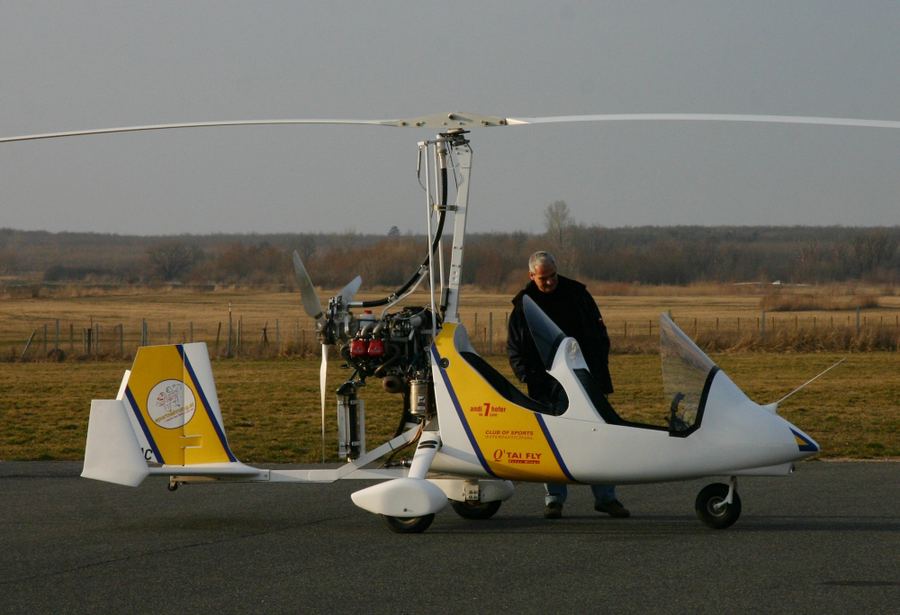
A gyrocopter's unpowered rotor spins freely from airflow passing upward through it, while a separate engine-driven propeller provides forward thrust, distinguishing its mechanics clearly from a helicopter's driven rotor.
Operations
Pilots operate gyrocopters by controlling rotor tilt for direction and using the throttle for forward speed, with takeoff typically requiring a short ground roll rather than a helicopter's vertical liftoff.
See also
References
| Category | Aircraft Types & Categories |
| Type | Rotorcraft (unpowered rotor) |
| Inventor | Juan de la Cierva, 1920s |
| First Flight | 1923, Spain |
| Status | Niche general aviation use |