
Overview
A baggage handling system is a conveyor-based system installed in airports that transports checked luggage from ticket counters to the areas where bags are loaded onto aircraft, and in reverse, moves arriving baggage to claim areas or onward connecting flights. The first automated baggage handling system was developed in 1971, and similar conveyor-based technology is now standard at nearly every major airport worldwide. Bags enter the system after being tagged with a unique barcode by an airline agent or self-service kiosk, and the system then scans and sorts each bag by airline and destination as it moves through the airport. Many airlines have also begun incorporating RFID chips into baggage tags to track bags in real time and reduce the number of pieces that get mishandled or lost in transit.
History
The first automated baggage handling system was developed in 1971, replacing the largely manual bag-sorting processes that had been standard at airports since commercial aviation began. Conveyor-based automated sorting spread rapidly through major airports over the following decades as passenger volumes grew and manual handling became increasingly impractical at scale. Barcode tagging, introduced to standardize how bags were tracked through these systems, became the industry standard by the late 20th century, and RFID chip tagging has more recently been adopted by a growing number of airlines to further reduce mishandled baggage rates.
Design & Specifications
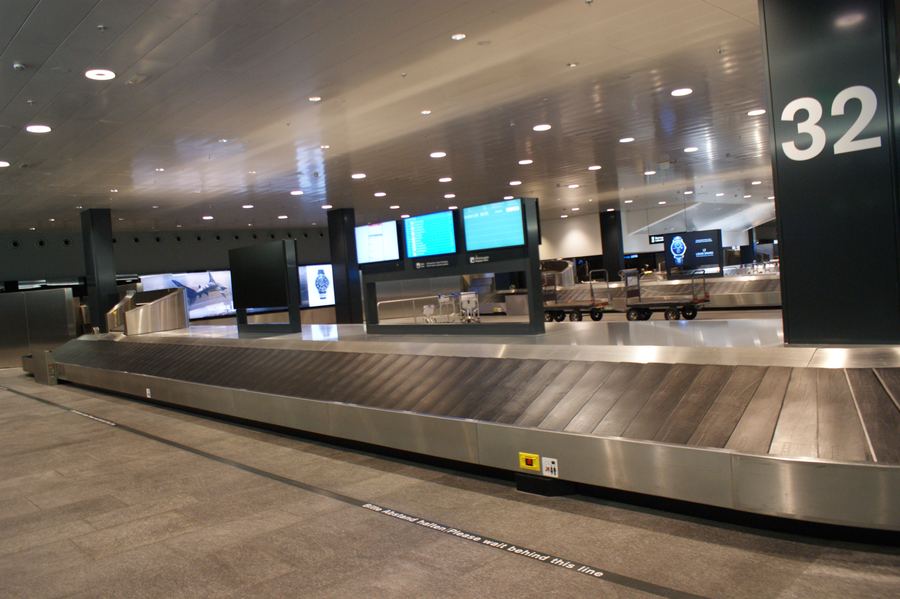
Modern baggage systems use an extensive network of conveyor belts running beneath the terminal, connecting check-in counters to sortation areas and ultimately to the aircraft loading zone or baggage claim carousel. Each bag is scanned at check-in, generating a unique barcode tag that the system reads at multiple points along the conveyor network to track and route it correctly. Automated sortation systems use this tracking data to divert each bag onto the correct branch of the conveyor network based on its destination flight, without requiring manual sorting by staff. Some airports have begun integrating RFID chip tags alongside barcodes, allowing bags to be tracked via radio signal even without a direct line-of-sight scan.
Operations
During a normal operating day, baggage systems process thousands of bags continuously, with the system's software managing routing priority so bags for departing flights closer to boarding time move through the network faster. When a bag is flagged for additional security screening, the system automatically diverts it to a dedicated screening area before allowing it to continue toward the aircraft. Baggage handling staff monitor system performance continuously, intervening manually when a bag jams, is misrouted, or requires special handling that the automated system can't manage. Airlines and airports track baggage mishandling rates closely, since lost, delayed, or damaged bags represent a significant driver of passenger complaints and compensation costs.
See also
References
| Category | Airport & Ground Infrastructure |
| Type | Conveyor-based sorting system |
| Introduced | 1971, first automated system |
| Tracking | Barcode, increasingly RFID |
| Status | Standard at major airports |