Overview
Combination aircraft, often called “combi” aircraft, are airliners built or modified to carry passengers and cargo simultaneously on the same main deck, usually divided by a movable partition with a reinforced floor and an oversized cargo door on the forward section. The concept dates to the early 1960s, when Northwest Airlines configured a Douglas DC-7C for mixed passenger and freight routes between New York and Tokyo, and it became common through the 1970s and 1980s on aircraft such as the Boeing 727, 737, and 747, flown by airlines including KLM, Lufthansa, and Air France. Combi configurations have declined sharply since the 2000s as dedicated freighters and passenger-only jets became more efficient, though a few regional operators continued using them into the 2010s and 2020s for routes with fluctuating passenger and freight demand.
History
Northwest Airlines pioneered the modern combi concept in the early 1960s, configuring a Douglas DC-7C to carry both passengers and freight on trans-Pacific routes between New York and Tokyo. The configuration became widespread through the 1970s and 1980s on aircraft such as the Boeing 727, 737, and 747, adopted by major carriers including KLM, Lufthansa, and Air France for routes where neither pure passenger nor pure cargo demand justified a dedicated aircraft. Combi use declined sharply from the 2000s onward as dedicated freighters and more efficient passenger-only aircraft made the mixed configuration less economical for most major airlines. A handful of regional and remote-area operators, particularly in Canada and Alaska, continued flying combi aircraft into the 2010s and 2020s to serve communities with fluctuating passenger and freight needs.
Design & Specifications
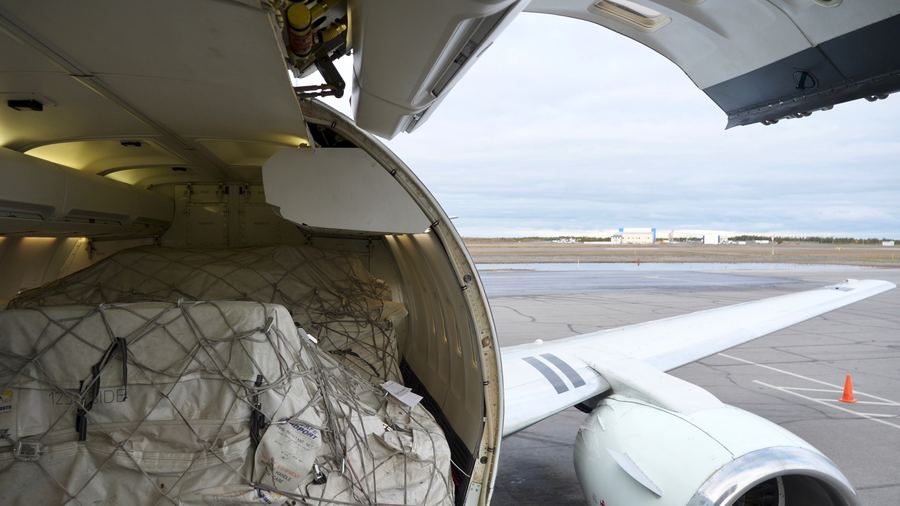
Combi aircraft feature a rigid partition dividing the main deck into a forward cargo section and a rear passenger cabin, with the cargo section built around a reinforced floor rated for heavy freight and a large forward main-deck cargo door for loading pallets. The passenger section behind the partition operates like any standard cabin, with normal seating, galleys, and lavatories, while the cargo section uses the same rail and roller loading system found in dedicated freighters. Weight and balance calculations for combi aircraft are more complex than for standard passenger or cargo configurations, since the split load between the two sections must be carefully managed to keep the aircraft's center of gravity within safe limits. The exact passenger-to-cargo ratio on a given combi aircraft can typically be adjusted between flights by repositioning the movable partition, giving operators some flexibility to match capacity to demand.
Operations
Combi aircraft operations require careful advance coordination between cargo and passenger handling teams, since both the freight and passenger loads must be finalized and weighed before the aircraft's overall weight and balance can be calculated. Loading sequence matters significantly on a combi flight, since cargo is typically loaded into the forward section before passengers board through a separate door further aft, keeping the two operations from interfering with each other on the ramp. Ground handling for a combi flight essentially combines the equipment and procedures used for both passenger and cargo flights simultaneously, requiring both passenger stairs or jet bridges and cargo loaders at the same aircraft. Because relatively few combi aircraft remain in service today, ground crews at airports that rarely handle combi flights may require additional coordination or training compared to routine passenger or all-cargo operations.
See also
References
| Category | Airline Business Models & Carrier Types |
| Type | Combi aircraft operator |
| Origin | Northwest Airlines, 1960s |
| Configuration | Passenger + cargo, same deck |
| Status | Rare; niche regional use |