
Overview
The fuselage is an aircraft's main body section, housing the crew, passengers, or cargo, and in single-engine aircraft it typically also contains the engine, though amphibious designs sometimes mount the engine on a pylon above the fuselage instead. Beyond simply housing occupants and cargo, the fuselage positions the aircraft's control and stabilization surfaces in the specific geometric relationships needed for overall stability and maneuverability. Several structural approaches are used to build fuselages, including welded steel-tube truss structures still common on lightweight aircraft, and stressed-skin monocoque or semi-monocoque designs that use the outer skin itself to bear structural loads, which is standard on most modern airliners. The choice of fuselage structure involves trade-offs between weight, strength, manufacturing cost, and ease of repair, and different approaches remain suited to different categories of aircraft.
History
Early aircraft fuselages, including the Wright Flyer, used simple open truss structures built from wood and wire bracing, prioritizing lightness over aerodynamic refinement or passenger comfort. Monocoque and semi-monocoque fuselage construction, which uses the outer skin itself to bear structural loads, emerged in the 1910s and 1920s and gradually became the dominant approach as aircraft speeds and sizes increased. Aluminum alloy construction became standard for most fuselages by the mid-20th century, offering a strong balance of strength and weight that dominated aircraft manufacturing for decades. More recently, composite materials such as carbon fiber reinforced polymer have been adopted for fuselage construction on newer aircraft like the Boeing 787 and Airbus A350, offering further weight savings over traditional aluminum structures.
Design & Specifications
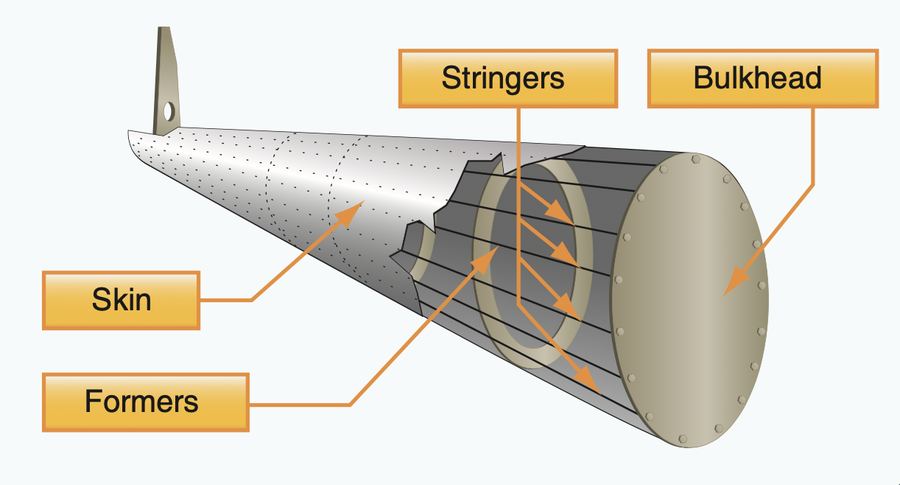
Fuselage construction uses either a truss framework, a stressed-skin monocoque shell, or a semi-monocoque combining internal frames with a load-bearing skin.
Operations
The fuselage houses the cockpit, cabin, and cargo areas throughout flight, maintaining structural integrity under pressurization and aerodynamic loads.
See also
References
| Category | Aerodynamics & Aircraft Anatomy |
| Type | Main aircraft body |
| Structure Types | Truss, monocoque, semi-monocoque |
| Modern Material | Aluminum or composite |
| Function | Houses crew, cargo, passengers |