
Overview
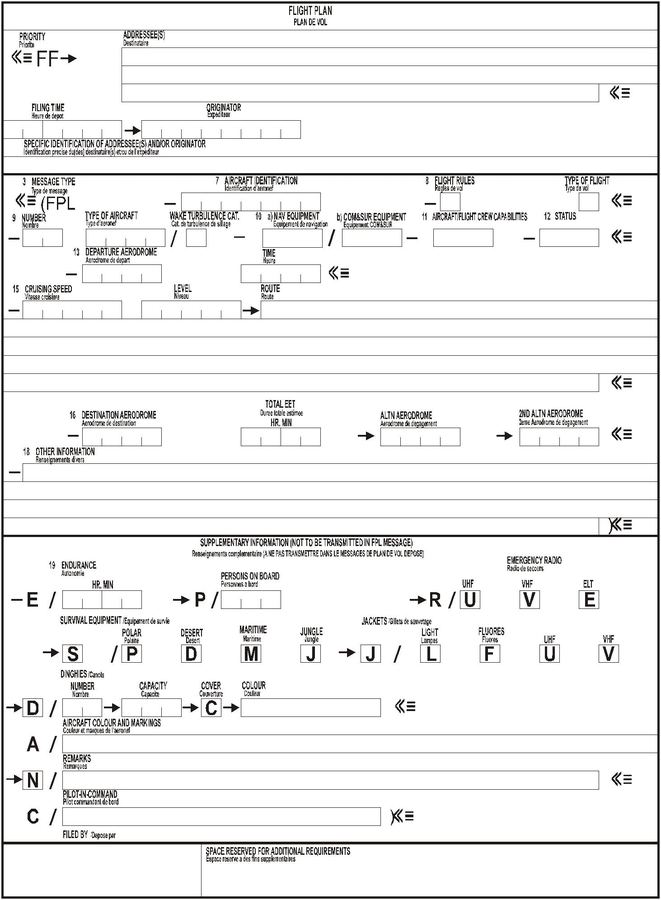
A flight plan is a document filed by a pilot or flight dispatcher with the local air navigation service provider, such as the FAA in the United States, prior to departure, indicating the aircraft's planned route or flight path; the standard flight plan format is specified in ICAO Document 4444. Flight plans generally include departure and arrival points, estimated time en route, alternate airports in case of bad weather, the type of flight — instrument flight rules (IFR) or visual flight rules (VFR) — pilot information, number of people on board, and details about the aircraft itself. In most countries, flight plans are mandatory for IFR flights but may be optional for VFR flights unless crossing international borders, though filing one is strongly recommended regardless, since it ensures search and rescue services know where to look if an aircraft goes missing. Flight plans also give air traffic control advance information about expected traffic, helping controllers manage airspace more efficiently even before a flight departs.
History
Formal flight plan filing requirements developed alongside the growth of air traffic control systems in the 1930s and 1940s, as controllers needed advance information about aircraft routes and intentions to manage increasingly crowded airspace safely. The International Civil Aviation Organization standardized flight plan format and content internationally through ICAO Document 4444, ensuring pilots and controllers worldwide could interpret flight plan information consistently regardless of country. Flight planning shifted from largely paper-based processes to increasingly digital and automated systems from the 1990s and 2000s onward, as computerized flight planning software began calculating optimal routes, fuel requirements, and alternate airports automatically. Modern electronic flight plan filing has become standard across most of the aviation industry, though the fundamental information a flight plan conveys has remained largely consistent with the ICAO standard established decades ago.
Design & Specifications
A flight plan documents route, altitude, aircraft details, and alternate airports in the standardized ICAO format recognized by air traffic control worldwide.
Operations
Pilots or dispatchers file flight plans before departure, with air traffic control using the filed information to sequence traffic and coordinate the flight along its route.
See also
References
| Category | Navigation, Meteorology & Rules |
| Type | Pre-flight route documentation |
| Standard Format | ICAO Document 4444 |
| Required For | IFR flights (mandatory) |
| Purpose | ATC coordination + SAR |