
Overview
Sustainable aviation fuel (SAF) is a jet fuel produced from renewable or waste-based feedstocks — such as used cooking oil, agricultural residue, or municipal waste — rather than crude oil, designed as a drop-in replacement usable in existing aircraft and airport fuel infrastructure without engine modifications. Because it's chemically similar to conventional jet fuel, SAF is typically blended with standard Jet A fuel up to certified limits, and it can reduce lifecycle carbon emissions substantially compared to fossil jet fuel, though the exact reduction depends heavily on the feedstock and production method used. Production remains a small fraction of total global jet fuel supply, constrained by high costs and limited refining capacity, but governments and airlines have set ambitious targets aimed at scaling up SAF production through the 2030s. Airlines, aircraft manufacturers, and fuel producers have widely positioned SAF as the primary near-term pathway for reducing aviation's carbon footprint, since battery-electric and hydrogen aircraft remain limited to smaller aircraft and shorter ranges for the foreseeable future.
History
Early experiments with biofuel-blended jet fuel began in the late 2000s, as airlines and fuel producers explored alternatives to fossil-based jet fuel amid growing climate concerns. The first commercial passenger flights using SAF blends took place in the early 2010s, and certification standards for SAF as a drop-in replacement usable in existing aircraft without modification were established over the following decade. Government mandates and airline sustainability commitments accelerated through the 2020s, though SAF production capacity has remained a persistent bottleneck, with actual output still representing a small fraction of global jet fuel demand relative to stated industry targets.
Design & Specifications
SAF is produced through several different certified pathways, including hydroprocessed esters and fatty acids from waste oils and fats, and alcohol-to-jet processes converting fermented sugars into jet fuel-compatible hydrocarbons. Because SAF is chemically similar but not identical to conventional jet fuel, it's certified for blending only up to a specific maximum percentage with standard Jet A or Jet A-1, rather than being approved as a complete standalone replacement. SAF production facilities require significant capital investment and specialized refining processes distinct from conventional petroleum refineries, contributing to its currently higher production cost compared to fossil jet fuel. Feedstock availability varies significantly by region, with some countries better positioned to source large volumes of used cooking oil, agricultural waste, or other qualifying SAF inputs than others.
Operations
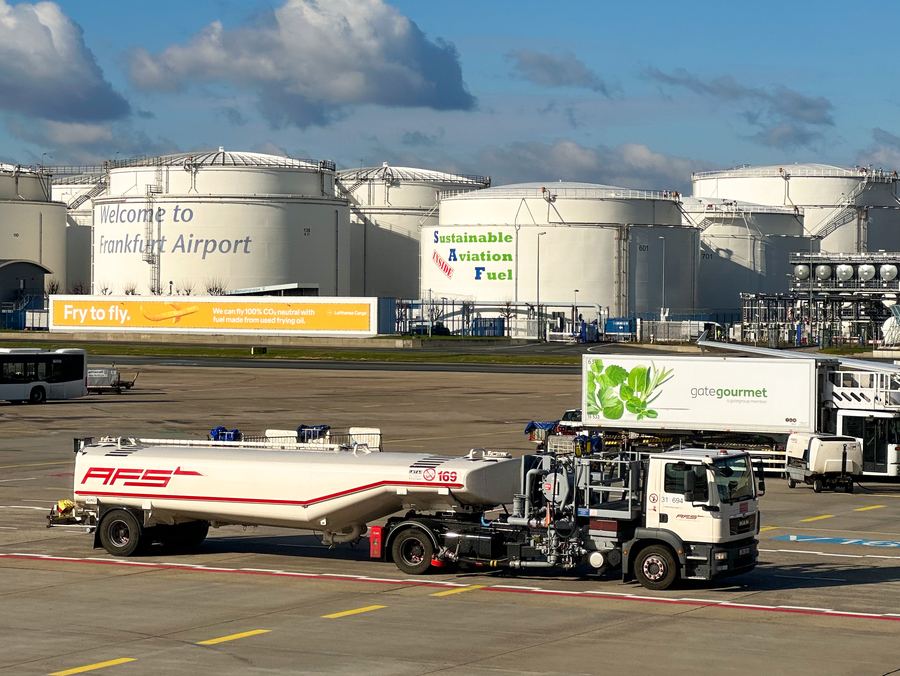
Airlines typically purchase SAF through dedicated supply agreements with producers, often blending it into the standard fuel supply at specific airports rather than dedicating entire flights exclusively to SAF-powered operation. Fuel delivered to an aircraft is usually a blend of conventional jet fuel and SAF up to the certified maximum percentage, meaning individual flights don't need any special handling once the blended fuel is loaded. Airlines and governments track SAF usage and associated emissions reductions through specific accounting frameworks, since the environmental benefit depends heavily on the feedstock and production method used for each batch. Corporate customers increasingly purchase SAF certificates to offset the emissions from their own business travel, funding SAF production even when their specific flight isn't necessarily using SAF-blended fuel directly.
See also
References
| Category | Fuel & Powerplants |
| Type | Renewable/waste-based jet fuel |
| Feedstocks | Used cooking oil, waste, residue |
| Introduced | First commercial flights, early 2010s |
| Status | Small but growing share |