
Overview
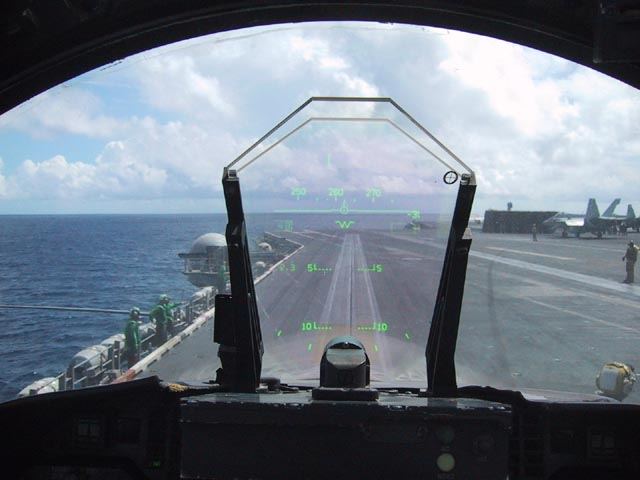
A head-up display (HUD), sometimes called a head-up guidance system (HGS), is any transparent display that presents data to a user without requiring them to look away from their normal viewpoint, allowing a pilot to view flight information while keeping their head up and eyes forward rather than angled down toward lower instruments. HUDs also offer the advantage that a pilot's eyes don't need to refocus between viewing the display and viewing the outside world, since the projected information appears to be at optical infinity rather than at the close range of a physical instrument panel. Although HUDs were initially developed for military aviation, where they helped fighter pilots track targets while maintaining visual contact with their surroundings, the technology has since spread to commercial aircraft, automobiles, and various other professional applications. In commercial aviation, HUDs are increasingly used to support precision approaches and landings in low-visibility conditions, giving pilots critical flight path information without diverting their attention from the runway.
History
Head-up display technology originated in military aviation during the 1950s and 1960s, developed specifically to let fighter pilots track targets and monitor critical flight information while keeping their eyes focused outside the cockpit during combat maneuvers. HUD technology matured significantly through the Cold War era as military aircraft increasingly relied on precise weapons delivery information being available without diverting a pilot's attention from the target. Commercial aviation adoption of HUD technology began in the 1990s and 2000s, primarily to support precision approaches and landings in low-visibility weather conditions where the technology's safety benefits were most valuable. HUD technology has since expanded well beyond aviation into automobiles and various other professional applications, though its aviation origins in military fighter cockpits remain the technology's clearest historical starting point.
Design & Specifications
A HUD projects flight information onto a transparent combiner glass positioned directly in the pilot's forward line of sight, using a projector unit mounted above and behind the display to create an image that appears to float at optical infinity. Displayed information typically includes airspeed, altitude, attitude, and, during an approach, a flight path guidance symbol showing the pilot exactly where the aircraft is heading relative to the runway. Commercial aviation HUD systems are integrated with the aircraft's flight management and navigation systems, drawing the same underlying data shown on conventional cockpit displays but presenting it in the pilot's forward view. Military HUD systems additionally integrate weapons targeting and threat information, reflecting the combat-focused origins of the technology.
Operations
Pilots use a HUD primarily during critical phases of flight such as takeoff, approach, and landing, when maintaining visual reference to the runway or outside environment while still monitoring flight instruments is especially valuable. During low-visibility approaches, a HUD can enable a pilot to continue an approach to lower decision altitudes than would otherwise be permitted, since the system provides precise guidance information without requiring the pilot to look down at conventional instruments. Training for HUD-equipped aircraft includes specific procedures for interpreting the display's symbology and recognizing when to prioritize HUD guidance versus outside visual reference. Maintenance of HUD systems includes periodic calibration checks to ensure the projected symbology remains precisely aligned with the aircraft's actual flight path and the pilot's eye position.
References
| Category | Avionics & Flight Systems |
| Type | Transparent flight display |
| Origin | Military aviation, 1950s-60s |
| Commercial Use | Precision low-visibility approach |
| Status | Expanding adoption |