
Overview
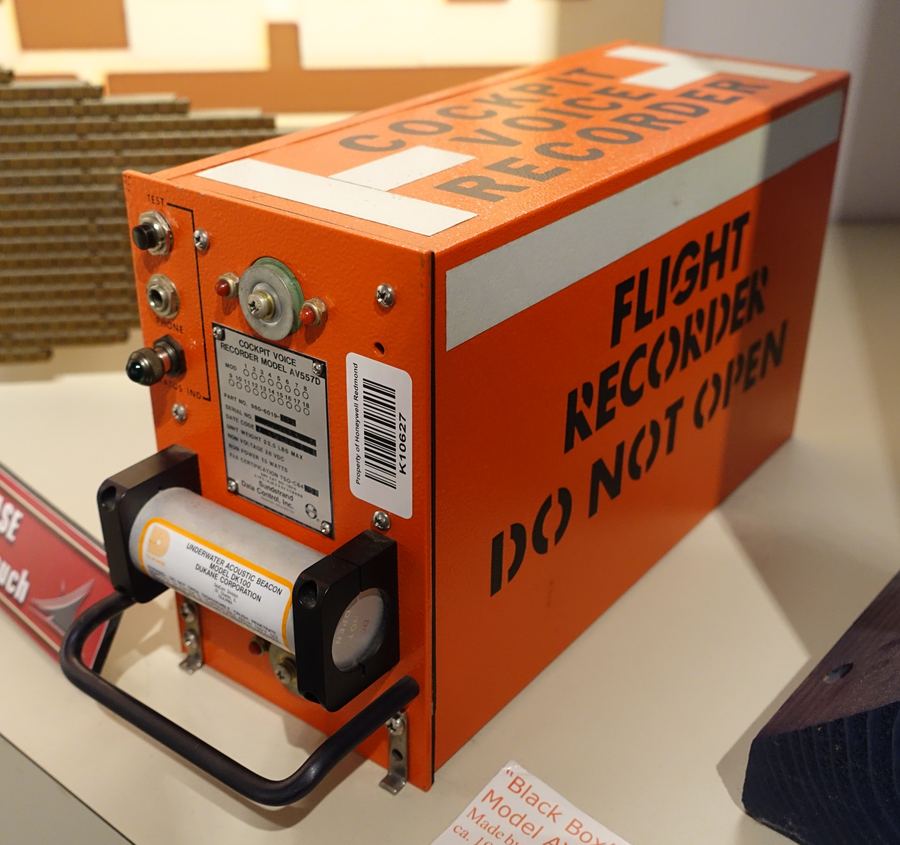
A cockpit voice recorder (CVR) is one of the two main types of flight recorder installed on an aircraft, specifically designed to capture audio from within the cockpit, including pilot conversations, radio communications, and ambient sounds such as engine noise or warning alarms. Alongside the flight data recorder, which captures technical flight parameters, the CVR provides investigators with crucial context for understanding crew decision-making and communication in the moments leading up to an accident or incident. Like all flight recorders, CVRs are built to survive extreme impact, fire, and, where relevant, underwater submersion, and they're painted bright orange despite the colloquial “black box” nickname, specifically to aid recovery after an accident. Most CVRs record on a continuous loop covering the most recent two hours of cockpit audio, ensuring the final moments before an incident are preserved even if the recorder isn't retrieved for some time.
History
Cockpit voice recorder technology developed alongside flight data recorders in the mid-20th century, as accident investigators recognized that technical flight data alone often couldn't explain why a crew made a particular decision in the moments before an incident. Early CVRs recorded only short loops of cockpit audio, but regulatory requirements gradually extended the mandatory recording duration as investigators found that longer recordings provided crucial additional context in complex accident investigations. CVR technology transitioned from analog magnetic tape to digital solid-state recording through the 1990s, significantly improving both recording quality and survivability in a crash. Modern CVRs remain mandatory equipment on virtually all commercial aircraft, and their recordings, combined with flight data recorder information, continue to serve as the two most important sources of evidence in modern aviation accident investigations.
Design & Specifications
A cockpit voice recorder captures audio from multiple microphones positioned throughout the cockpit, including a dedicated area microphone that picks up ambient sounds along with individual crew headset channels. The recorder continuously overwrites its storage on a rolling basis, retaining only the most recent recording period, historically around 30 minutes but extended to two hours or more on many modern aircraft following regulatory updates. Like other flight recorders, the CVR's core memory unit is built to survive extreme crash forces, fire, and water immersion, housed within the same crash-survivable casing standard used for flight data recorders. Recording quality and channel separation have improved substantially with digital recording technology, letting investigators distinguish individual crew members' voices and identify background sounds like warning tones or engine noise more clearly than older analog systems allowed.
Operations
The CVR records automatically from engine start to shutdown on every flight, requiring no action from the flight crew to activate or manage the recording process. After an accident, investigators carefully extract and analyze the audio, sometimes using specialized software to isolate specific sounds or voices from the recording for detailed review. CVR transcripts, once processed, are cross-referenced against the flight data recorder's technical parameters to build a complete timeline of both what the aircraft was doing and what the crew was saying and doing during the final moments of a flight. Due to privacy and labor relations concerns, CVR recordings are typically handled under strict confidentiality protocols, with full raw audio rarely released publicly even after an investigation concludes.
See also
References
| Category | Avionics & Flight Systems |
| Type | Cockpit audio recorder |
| Records | ~2 hours, continuous loop |
| Paired With | Flight data recorder |
| Status | Mandatory on commercial aircraft |