
Overview
Paragliding is the recreational and competitive sport of flying paragliders — lightweight, free-flying, foot-launched glider aircraft with no rigid primary structure — in which the pilot sits in a harness or pod-like seat suspended below a fabric wing. The wing's shape is maintained by suspension lines, the pressure of air entering vents at the front of the wing, and the aerodynamic forces of airflow passing over its surface. Despite carrying no engine, paraglider flights can last several hours and cover many hundreds of kilometers under favorable conditions, though flights of one to five hours covering tens of kilometers are more typical. By skillfully exploiting rising air currents, paraglider pilots can climb to altitudes of several thousand meters, making the sport a genuine cross-country flying discipline rather than simply a short descent from a launch point.
History
Paragliding emerged in the late 1970s and early 1980s, developing directly out of skydiving parachute technology as enthusiasts began modifying ram-air parachute canopies for sustained foot-launched flight rather than simply descent. Early paraglider wings had modest performance, limiting flights to short glides down hillsides, similar to early hang gliders of the same era. Wing design improved substantially through the 1980s and 1990s as manufacturers refined canopy shape and materials specifically for paragliding rather than adapting parachute designs, dramatically improving achievable flight duration and distance. Paragliding has continued growing as both a recreational and competitive sport into the 21st century, aided by improved safety equipment and a global network of dedicated flying sites exploiting reliable thermal and ridge lift conditions.
Design & Specifications
A paraglider's fabric wing inflates from ram-air pressure entering vents at the leading edge, with the pilot suspended below in a harness and steering via brake lines attached to the wing's trailing edge.
Operations
Pilots launch by running downhill or via tow, then control the wing using brake toggles to steer and adjust speed, seeking thermal lift to extend flight duration and distance.
See also
References
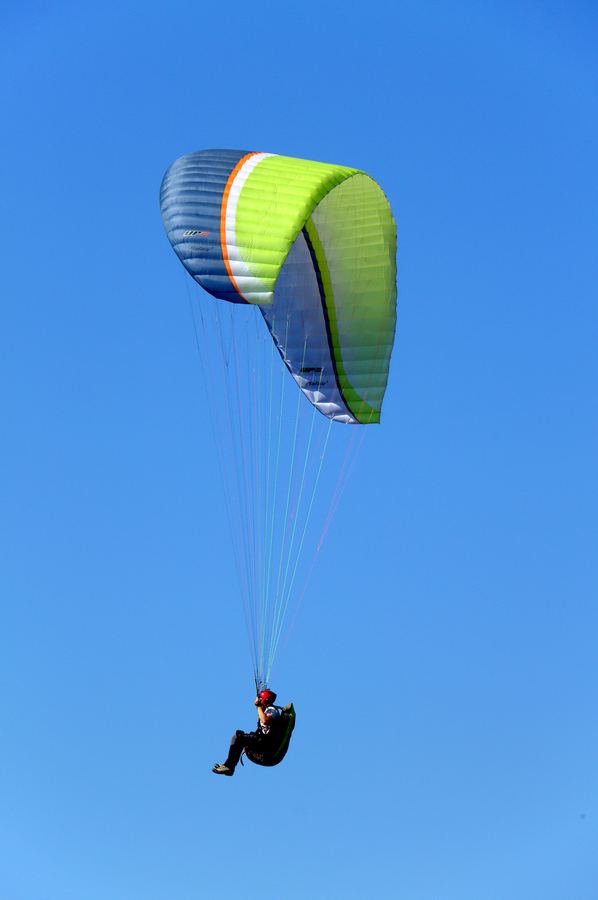
| Category | Aircraft Types & Categories |
| Type | Foot-launched flexible-wing glider |
| Origin | Skydiving parachute tech, late 1970s |
| Modern Sport Era | 1980s-90s refinement |
| Status | Active recreational sport |