
Overview
A helicopter is a type of rotorcraft in which lift and thrust are supplied by horizontally spinning rotors, allowing it to take off and land vertically, hover in place, and fly forward, backward, and laterally. These capabilities let helicopters operate in congested or isolated areas where fixed-wing aircraft and most short-takeoff aircraft can't function without a runway. The Focke-Wulf Fw 61, first flown in 1936, is generally recognized as the first successful, fully controllable helicopter, and the Sikorsky R-4 became the first helicopter to reach full-scale production in 1942. Since then, helicopters have become essential across military, medical, law enforcement, and commercial applications, valued specifically for their ability to access locations completely inaccessible to fixed-wing aircraft.
History
Leonardo da Vinci sketched early helicopter-like concepts centuries before powered flight was possible, though practical helicopter development didn't begin in earnest until the early 20th century. The Focke-Wulf Fw 61, first flown in Germany in 1936, is widely credited as the first successful, fully controllable helicopter, solving key stability and control challenges that had stymied earlier attempts. Igor Sikorsky's R-4, which entered full-scale production in 1942, became the first mass-produced helicopter, seeing operational military use before World War II's end. Helicopter technology matured rapidly through the mid-20th century, expanding from military use into medical evacuation, law enforcement, offshore transport, and countless other civilian roles that have made helicopters indispensable across many industries today.
Design & Specifications
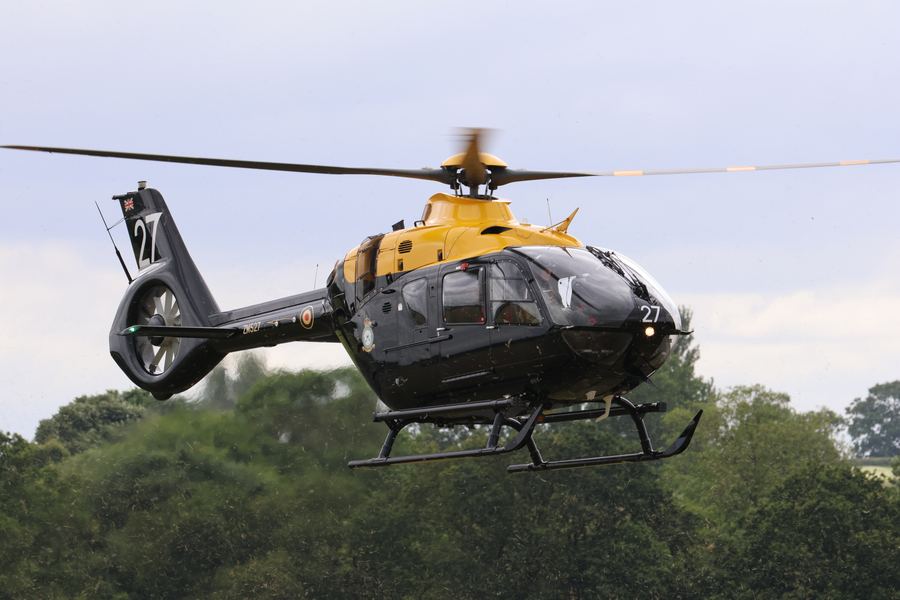
Helicopters use one or more powered main rotors for lift and a tail rotor or alternative anti-torque system to counteract the main rotor's rotational force, giving them vertical takeoff and hover capability.
Operations
Pilots control a helicopter using cyclic and collective controls to adjust rotor blade pitch, allowing precise hovering, vertical ascent, and directional flight not possible with fixed-wing aircraft.
See also
References
| Category | Aircraft Types & Categories |
| Type | Rotary-wing aircraft |
| First Practical Example | Focke-Wulf Fw 61, 1936 |
| First Mass-Produced | Sikorsky R-4, 1942 |
| Status | Widespread civil + military use |