
Overview
Thrust is a reaction force described by Newton's third law: when a system expels or accelerates mass in one direction, an equal and opposite force is applied back to that system. In aircraft propulsion, this mass is typically air accelerated backward by a propeller or jet engine, generating the forward force needed to overcome drag and accelerate the aircraft. Thrust is measured in newtons under the International System of Units, or in pounds-force in some contexts, and modern high-performance jet engines can produce well over 40,000 pounds of thrust from a single engine. The relationship between an aircraft's available thrust and its weight and drag directly determines its acceleration, climb rate, and maximum speed, making thrust-to-weight ratio a key performance metric across virtually every category of aircraft.
History
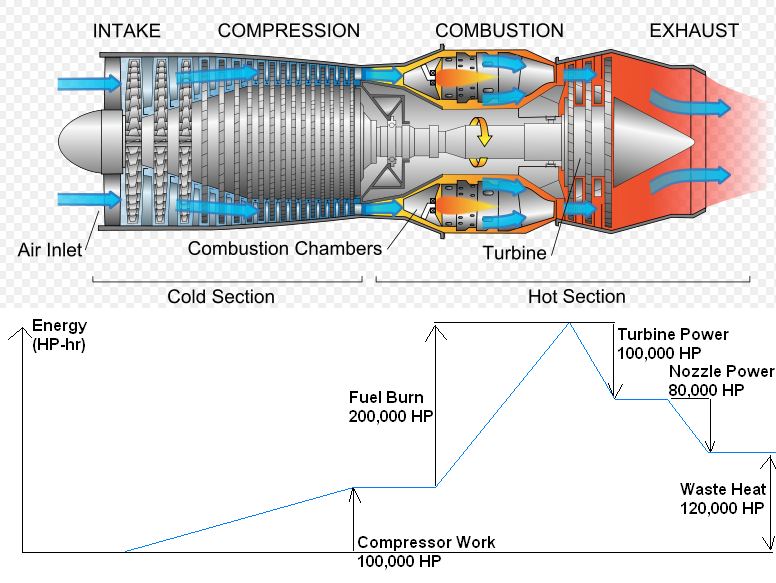
Early aircraft relied entirely on propeller-driven thrust, generated by piston engines turning wooden or metal propellers, a configuration that remained standard for the first several decades of powered flight. Jet propulsion, developed independently in Germany and Britain in the late 1930s and first flown in 1939, introduced a fundamentally different way of generating thrust by directly accelerating exhaust gases rather than turning a propeller. Jet engines came to dominate military and later commercial aviation through the mid-20th century, offering far greater thrust and higher achievable speeds than piston-propeller combinations could provide. Turbofan engines, developed from the 1960s onward, later combined elements of both approaches, using a ducted fan alongside a jet core to improve efficiency while retaining the higher thrust output that made jets dominant in the first place.
Design & Specifications
Thrust is generated by propellers or jet engines accelerating air or exhaust gases rearward, with output measured and controlled through the engine's throttle setting.
Operations
Pilots manage thrust via throttle controls to accelerate, maintain speed, or decelerate throughout each phase of flight.
See also
References
| Category | Aerodynamics & Aircraft Anatomy |
| Type | Forward propulsive force |
| Physics Basis | Newton's third law |
| Measured In | Newtons or pounds-force |
| Modern Jet Output | 40,000+ lbf per engine |